ARIZONA MONSOON PROTECTION
Security Screens vs. Storm Shutters: Which Is Better for Arizona Monsoon Season?
A side-by-side look at cost, protection, and year-round value for Phoenix homeowners
Arizona monsoon season runs roughly mid-June through the end of September, and every year Phoenix homeowners watch dust walls roll across the Valley, lightning crack over the Estrellas, and microburst winds tear through their neighborhoods at 60 to 80 miles per hour.
When the storms hit, two product categories come up over and over: storm shutters and security screens. They look different, work differently, and cost very different amounts — and most homeowners only need one. This guide breaks down which one actually makes sense for an Arizona home.
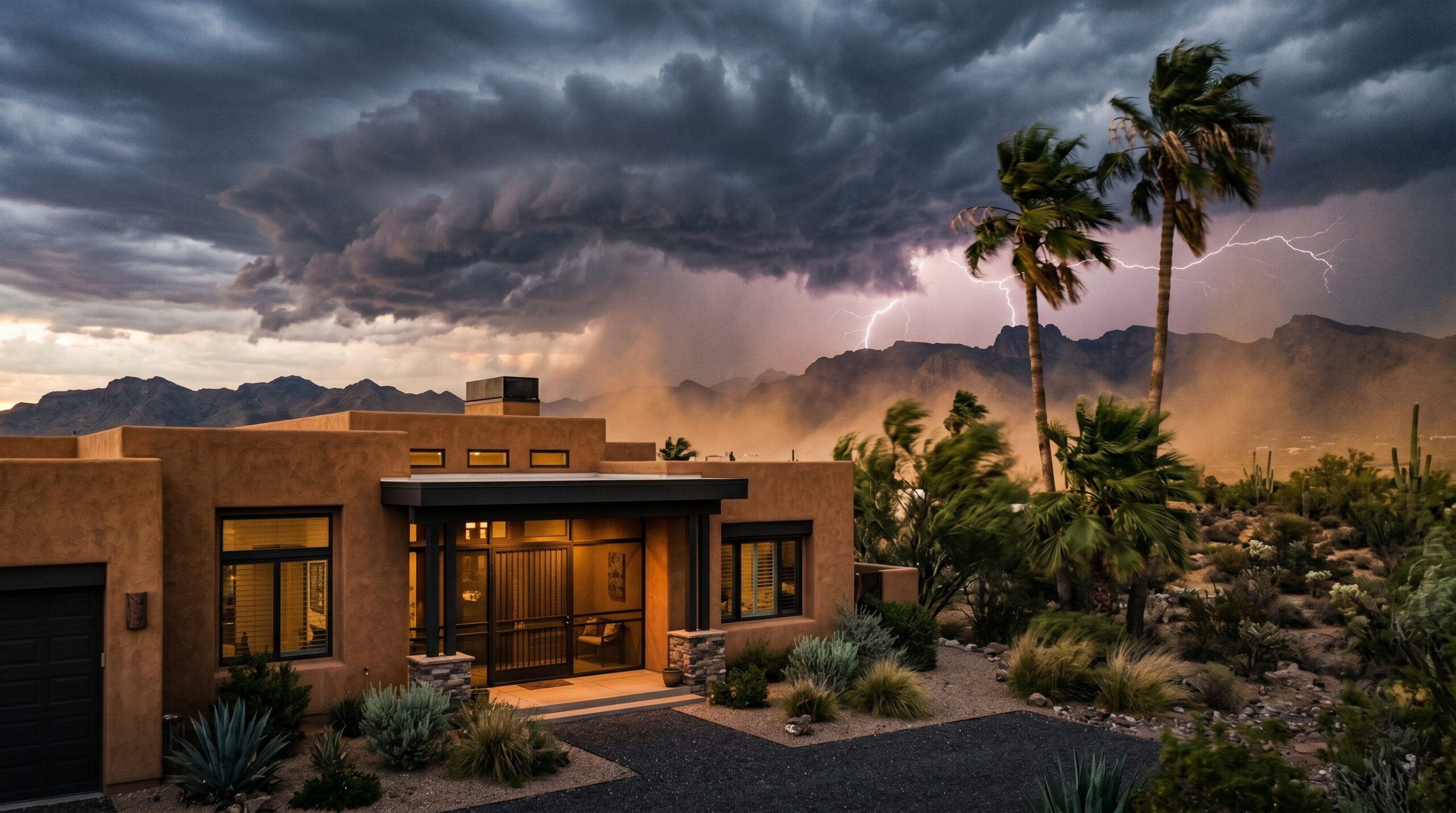
A Phoenix-area home weathering a monsoon. Wind, dust, and flying debris are the real threats — not water.
~107
Days of Arizona monsoon season each year
80 mph
Microburst wind gusts recorded in Phoenix monsoons
365
Days a year security screens stay on the job
What Storm Shutters Actually Do
Storm shutters are designed for one job: shield window glass from flying debris during a severe weather event. They come in several styles — accordion, roll-down, Bahama, colonial, and removable panel — and the better systems are rated to deflect impacts that would otherwise shatter a window.
That is genuinely useful in hurricane-prone coastal markets, where storm shutters were originally engineered. But Arizona is not Florida. Phoenix sees dust storms and microbursts, not Category 3 hurricanes. The actual monsoon threats are:
- Wind-driven dust and grit sandblasting glass, screens, and finishes
- Loose debris — landscaping rocks, palm fronds, patio furniture, trash cans
- Sudden microburst gusts that can drive a small object into a window
- Heavy rain that finds gaps around older window frames
Storm shutters address one of those risks: a hard impact to the glass. They do nothing about the other 350-plus days of the year, and they do nothing about break-ins, the second-leading reason Arizona homeowners harden their windows in the first place.
What Security Screens Do — All Year, Every Day
Security screens are stainless steel mesh panels mounted in heavy-duty aluminum frames that install over your existing windows and doors. The mesh is woven tight enough that you can barely see it from inside, but a knife, crowbar, or thrown rock cannot get through it.
Here is what that means in an Arizona monsoon:
- Debris stops at the screen. A landscaping rock or palm frond hits the stainless mesh, not your glass.
- Windows stay open during storms. Because the screen is the barrier, you can leave windows cracked for airflow without exposing the home to debris or intruders.
- Insects, dust, and pests are filtered out. Standard fiberglass insect screens shred in monsoon winds. Stainless mesh does not.
- UV and heat are reduced. Most security screens block 60 to 65 percent of solar heat gain, which lowers cooling costs the rest of the year.
Most importantly, security screens stay on the home 365 days a year. There is nothing to deploy, no shutters to close, and nothing to do when the storm warning hits — the protection is already in place.
Side-by-Side: Storm Shutters vs. Security Screens
Protection from flying debris: Both perform well. Storm shutters shield the glass directly; security screens stop the object before it ever reaches the glass.
Burglary & forced-entry protection: Storm shutters offer almost none. Security screens are engineered specifically to defeat forced-entry attempts and hold up to repeated impact.
Year-round value: Storm shutters sit unused for 9-plus months a year. Security screens deliver heat reduction, insect protection, ventilation, and break-in protection every single day.
Deployment effort: Most storm shutters require manual closing, panel installation, or motorized deployment when a storm is forecast. Security screens are always deployed.
Curb appeal: Closed shutters look like a fortress. Modern security screens are nearly invisible from the curb and come in custom colors to match the home.
HOA acceptance: Many Phoenix-area HOAs restrict the appearance of storm shutters when they are not in active use. Security screens generally pass HOA review because they look like upgraded screen doors and windows.
💡 Phoenix Reality Check: Wind, Not Water
The single biggest monsoon threat to most Phoenix homes is not water intrusion or hurricane-force winds — it is airborne debris driven by 60 to 80 mph microbursts. Anything that stops a rock or palm frond from reaching your glass is doing the job. Security screens do that, and they do it without you ever lifting a finger when the dust wall arrives.
The 10-Year Cost Picture
Sticker prices on storm shutters and security screens are in similar ballparks for a typical Phoenix home, but the long-term math favors screens for one reason: storm shutters are a single-purpose product, and security screens stack multiple benefits.
Over 10 years, a Phoenix home with security screens typically sees:
- Lower cooling costs from reduced solar heat gain — often hundreds of dollars per year on monthly utility bills
- Possible insurance discounts for verified physical security upgrades
- Reduced break-in risk — the average burglary loss in Arizona runs into the thousands of dollars per incident
- No replacement cost for shredded standard insect screens after big monsoon events
Storm shutters do not contribute to any of those line items. Whatever you spend on shutters is purchasing storm-day protection only — useful, but a narrow return for the price.
When Storm Shutters Still Make Sense
This is not a one-size-fits-all answer. Storm shutters can be the right call for a few specific Arizona scenarios:
- Oversized picture windows that exceed the practical span of a single security screen frame
- Historic homes where the architectural look of colonial or Bahama shutters is part of the design intent
- Vacation homes sitting empty for long stretches where motorized roll-down shutters add a closed-up “I am not here to break into” signal
For everyone else — the typical owner-occupied Phoenix metro home — security screens cover the same monsoon-debris job and add break-in protection, heat reduction, and 365-day value that shutters cannot match.
Common Questions From Phoenix Homeowners
“Do I need both storm shutters and security screens?”
For nearly every Phoenix-area home, no. Security screens handle the realistic Arizona monsoon threats and add year-round benefits storm shutters cannot.
“Will security screens actually stop a flying rock?”
Yes. Stainless steel mesh in a properly installed frame is engineered to absorb impact and deflect debris that would otherwise hit your window glass.
“What about hail?”
Severe hail is rare in the Phoenix metro, but security screens absorb hail impact better than bare glass and dramatically reduce the risk of glass damage during the occasional hailstorm.
“Can I open my windows during a monsoon if I have security screens?”
Yes — that is one of the biggest advantages. With a security screen in place, you can leave the window open behind it for airflow without leaving the home open to debris or break-ins.
Get Monsoon-Ready Before the First Storm Hits
Paramount Security Screens engineers stainless steel security screens for every window and door style across the Phoenix metro. One install — protection from monsoons, break-ins, heat, and dust for the life of your home.
Call us: (602) 214-7005 | Licensed & Insured | ROC #353818
Explore More From Paramount Security Screens
- residential security screens
- our security screen products
- our lifetime warranty
- Security screens in Scottsdale & Chandler, AZ